How to Read a GLOW Peptide COA Before You Place an Order
A certificate for a three-peptide blend has more to read than most. This walk-through covers each part of a GLOW report and the limits worth keeping in mind.
Most buyers glance at a Certificate of Analysis, spot a percentage, and move on. With a three-component blend that's not enough. A GLOW peptide COA has more ground to cover than a report on a single peptide, and the useful detail is spread across several sections.
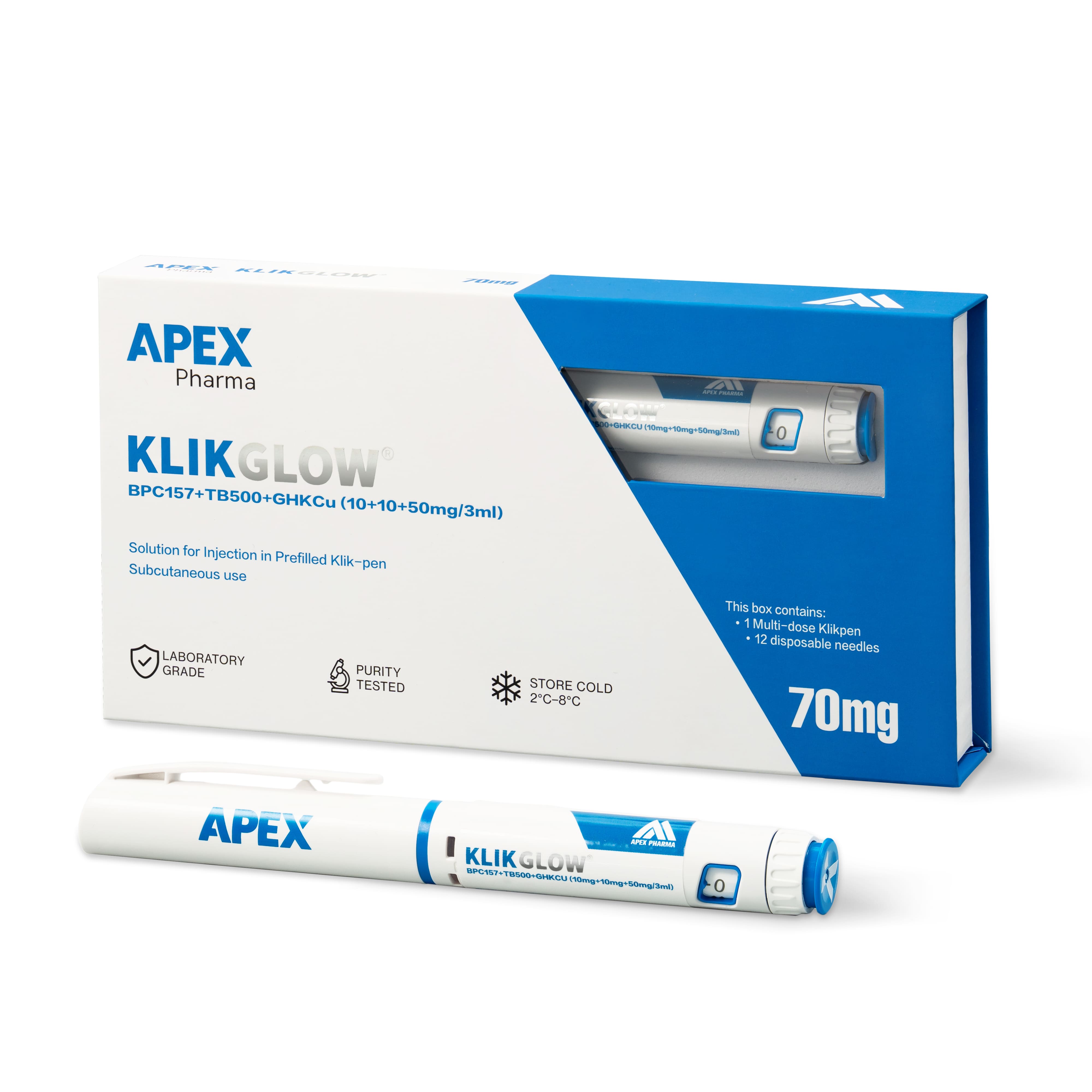
GLOW contains BPC-157 10mg, TB-500 10mg and GHK-Cu 50mg in one 3ml pen, labelled KLIKGLOW. A report on the blend may therefore say something about each of three components, and the sections that tell you what was tested matter as much as the figures themselves.
Here's how to read one before you order, section by section, plus the questions to ask if something isn't covered.
Where to find a GLOW report
CLOVA publishes reports on the Certificates of Analysis page and on the relevant product page, where a report is available for that batch. Not every batch will have one at any given moment, so check before assuming.
Open the full document rather than relying on a thumbnail or a single quoted figure. Cropped images often leave out the sample description and the notes, which are exactly the parts you need.
The header, or who issued the report and when
Start at the top. A report normally identifies who carried out the analysis and when it was issued. Note both.
The date matters because reports relate to a specific batch at a specific time. A report issued long before the batch you'd receive may concern earlier stock. That isn't a fault, but it does mean you should check the batch number rather than assume the report is current.
The sample section
This is the part people skip, and it's arguably the most important. The sample description tells you what was actually sent for testing. For GLOW you'd expect it to refer to the finished blend, not to one of its ingredients in isolation.
Look for a batch or lot number here. Later, when your pen arrives, you'll match the batch number on the label against this one. If the report doesn't carry a batch number at all, make a note, because you'll have nothing to match against.
The results section, three components and three sets of figures
A blend report may present results for each component separately. As you read, keep three kinds of finding apart:
- Identity, meaning whether each expected component was detected
- Measured content, meaning how much of each component was found, with its unit
- Purity, meaning the proportion of the sample attributed to the expected material
These aren't interchangeable. A high purity figure doesn't tell you the measured content, and a content figure doesn't confirm identity on its own. If the report gives figures for only one or two of the three components, write down which ones are covered and which aren't.
Compare any measured content with the stated amounts of 10mg, 10mg and 50mg, keeping the units intact. Don't convert or combine figures to make the comparison look neater.
What a COA can't tell you
A certificate describes a sample at the time it was tested. It doesn't describe how the product was stored afterwards, and it can't speak for batches it didn't cover.
It also says nothing about uses. GLOW is supplied for research use only, and a report is a record of composition, not a statement about what the material does.
A before-you-order checklist
Run through these points before committing to a purchase:
- The report is the complete document, not an excerpt
- The issue date is recorded
- The sample description refers to the GLOW blend
- A batch number is shown, so you can match it on arrival
- Results cover all three components, or the gaps are noted
- Identity, content and purity findings are recorded separately
- Units are kept exactly as the report states them
If points 3 to 5 leave questions, ask CLOVA before ordering. Give the report you looked at and say precisely what's missing, for example "the report shows results for two of the three components". A focused question gets a more useful answer than a request to "send the COA".
Frequently asked questions
Is a report on GHK-Cu alone enough for GLOW?
Not as a certificate for the blend. A single-ingredient report describes that ingredient, while the GLOW pen is a finished three-component product. Treat it as background and look for a report on the blend batch itself.
Can I read the COA before ordering?
Where a report is available for a batch, it's published on the COA page and the product page, so you can review it in advance. If you can't find one, ask CLOVA whether a report exists for current stock.
Will the report tell me how to store GLOW?
Usually not, as storage guidance comes from the label and the product information. GLOW should be kept at 2–8°C, away from light, and not frozen.