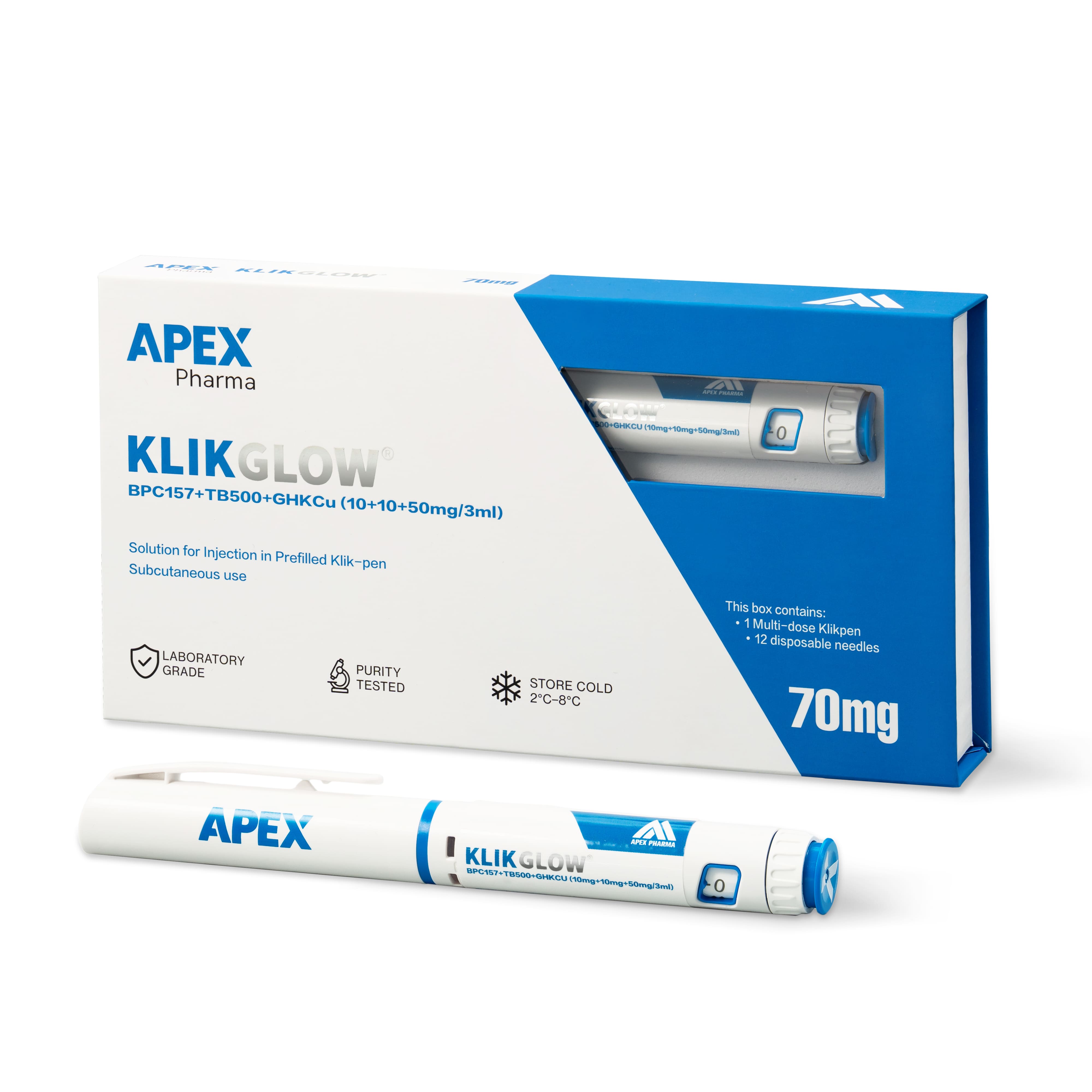
70mg, 50mg or 3ml? Reconciling the Numbers in GLOW Order Records
When the order says one number and the stock sheet says another, both may be right. Here is how to label each GLOW figure so your records stop contradicting each other.

A lab manager opens the stock sheet and sees "GLOW 70". The purchase order says "GLOW x3". A technician's handwritten note says "GLOW 50mg". Three records, three numbers, and a fair question: which one is wrong?
Quite possibly none of them. The GLOW peptide 70mg figure, the 50mg figure and the number of pens ordered all describe different things. Trouble starts only when a figure loses its unit or its subject, and someone later reads it as something else.
This article sets out what each GLOW number means, then walks through tidying records like the ones above without overwriting their history.
Six figures you may see attached to GLOW
The GLOW blend is a single pen labelled KLIKGLOW. Each of these figures is legitimate, but each refers to something different:
| Figure | What it describes |
|---|---|
| 70mg | Total stated peptide content of one pen |
| 50mg | GHK-Cu content of one pen |
| 10mg | BPC-157 content of one pen |
| 10mg | TB-500 content of one pen |
| 3ml | The pen's volume |
| x3, 2 units and so on | How many pens were ordered or received |
Notice that two components share the same 10mg figure. A record that just says "10mg" can't tell you which one is meant, so the component name always needs to travel with the number.
Trace each figure back to where it came from
Before changing anything, work out the source of every number in your records. Was it copied from the label, the listing, an invoice, a report or someone's memory? Write the source next to it.
This step usually explains most of the apparent conflicts. A figure from an invoice is probably a count of pens. A figure from the label is a content statement. A figure from a Certificate of Analysis is a measured result for a particular batch, which is a different kind of statement again.
Avoid creating new numbers by dividing or multiplying the ones you have. Your record should hold figures that appear on the label, listing or report, each with its unit and subject.
A worked example
Back to the three records at the start.
- "GLOW 70" on the stock sheet has lost its unit. It almost certainly means 70mg total content per pen, but the sheet should say so.
- "GLOW x3" on the purchase order is a quantity of pens. It isn't a content figure at all.
- "GLOW 50mg" in the note is the GHK-Cu component, written as though it described the whole pen. That's the one most likely to mislead.
None of these needs deleting. Each needs a unit, a subject and, ideally, a source.
Tidying the record without losing its history
When you correct a record, keep the old entry visible and add the clarified one alongside it. A simple checklist helps:
- Every figure has a unit (mg, ml or pens)
- Every content figure names its component, or says "total"
- Pen counts sit in a separate quantity field, not alongside content figures
- The label name KLIKGLOW and the batch number are recorded
- Each figure notes its source (label, listing, invoice or report)
- A short note explains what was changed and why
The last item matters more than it seems. "Clarified unit, no change to stock" tells a later reader something quite different from "corrected stock count". Those explanations support different conclusions, so don't let one replacement figure hide which kind of correction happened.
When the numbers genuinely don't agree
Sometimes, after labelling everything, a real difference remains. The label might say one thing and a document you were sent another, for the same component on the same batch.
Don't choose the more convenient figure. Check the Certificates of Analysis page for a report matching the batch number on your label, where one is available, and compare like with like. If the gap is still there, send CLOVA both statements word for word with the batch number and ask which applies. Record the answer exactly as given, along with the date you received it.
Throughout, remember what these records are for. GLOW is sold for research use only, so the job of a quantity record is simply to describe what you hold, accurately and traceably.
Frequently asked questions
Is 70mg the amount of each peptide in GLOW?
No. 70mg is the stated total for the pen. It's made up of BPC-157 10mg, TB-500 10mg and GHK-Cu 50mg, so any record that uses 70mg should label it as the total.
Should the 3ml figure go in our quantity field?
It's better recorded as a description of the pen than as a quantity. Keep the quantity field for the number of pens, and record 3ml alongside the product description so it isn't mistaken for a content figure.
What if a COA figure differs slightly from the label?
A label states what the product contains, while a report records what was measured for a specific batch. Keep both as they are, note that they are different kinds of statement, and ask CLOVA if you need the difference explained.